

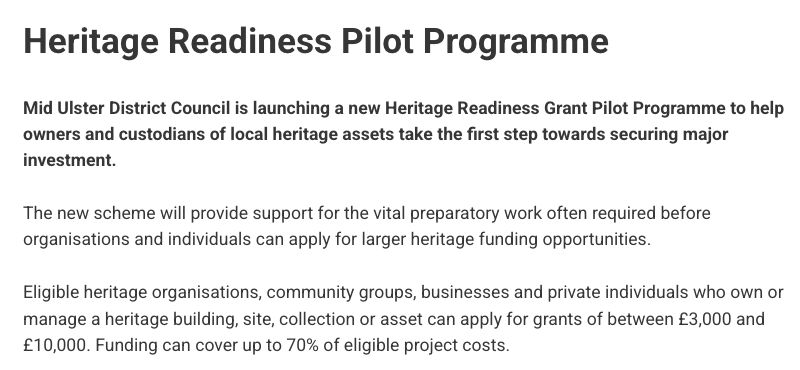
Mid Ulster District Council opened applications on Monday, 2 November, for a heritage pilot offering grants of £3,000 to £10,000 towards the surveys, studies and plans needed before a larger funding bid.
The Heritage Readiness Grant Programme can cover up to 70% of eligible costs. Its defining limit is equally important: it pays towards preparation, not building repairs, construction or delivery of the eventual heritage project. Applications close at noon on Monday, 23 November, with an online information session scheduled for noon on Wednesday, 4 November.
The new application window concerns heritage assets within Mid Ulster District Council’s area in Northern Ireland. It is not a scheme for the whole of Ulster or a Republic of Ireland grant, and the amounts are in pounds sterling. Eligible community organisations, businesses and private owners face different requirements, set out in the council’s public application record.
The Press checked the live grant listing and the council’s programme page on 2 November. The opening and closing timestamps in the public portal match the council’s stated times: 9am GMT on 2 November and noon GMT on 23 November. A portal viewed from another time zone may display localised times; the times in this article are those applying in Northern Ireland.
The opening funds a preparatory step
The council’s announcement, published in its October news archive, set out the pilot ahead of today’s opening. The material change now is that the application form is listed on the live grants portal. The council is also inviting prospective applicants to the briefing later this week.
Examples of work identified by the council include condition surveys, conservation management plans, feasibility studies and business plans. Assessment and cataloguing of archives or collections can also fall within the preparatory purpose. These are different outputs, so an application needs to explain the particular information a future project requires.
For a building, a survey might establish its condition before a future repair proposal is developed. For an archive, preparatory assessment could help define the material involved and the work a later funding application would seek to support. Those are illustrative ways to understand the scheme’s purpose, not confirmation that a particular commission will be funded.
The council describes the programme as a pilot within its draft heritage strategy. It says the intention is to improve the readiness and quality of applications to larger heritage funders. Neither that objective nor an eventual readiness award amounts to a promise that a later funding bid will succeed.
The asset must be in the district
The public application record identifies three broad applicant groups: constituted not-for-profit organisations; businesses, including companies, partnerships and sole traders; and private individuals owning or leasing an appropriate heritage asset.
Location is a substantive condition. The heritage asset, collection or area to which the work relates must be within Mid Ulster District Council’s area. The portal separately says that not-for-profit applicants, including charities, must also be based in the district. An owner living elsewhere should not confuse their own address with the location requirement applying to the asset.
For businesses and private individuals, the record also requires the proposal to bring a heritage or listed building, site or asset back into use and demonstrate benefits extending to the wider public and surrounding area. A benefit confined to the owner is not the same as the community benefit described in the programme.
These are general published criteria, rather than an eligibility decision for any individual property or organisation. The council’s assessment and full guidance determine whether a particular proposal fits. Applicants with uncertain boundaries, mixed ownership or an unusual asset should resolve those points through the official route.
Ownership and custody need evidence
For a building or land, the public record requires ownership or a lease with at least 15 years remaining when the application is made, together with the owner’s written consent where applicable. Successful applicants must provide ownership or lease evidence at the Letter of Offer stage.
Archives and collections have a different form of control: the applicant must own the material or be its named custodian under a written agreement. The portal notes an exception to the ownership requirement for a heritage audit of a village or area. That distinction may matter to a community group proposing to research several assets it does not itself own.
A clear description of the asset and the applicant’s relationship to it therefore belongs near the start of the proposal. A project can have a worthwhile heritage purpose while still needing evidence about who can authorise the preparatory work and use its results.
The programme also requires an account in the relevant organisation’s or business’s name, or the individual applicant’s own name. Readers should supply supporting material only through the official application process; The Press does not collect application documents, ownership records or banking information.
Community organisations have additional governance conditions
Constituted not-for-profit applicants need a signed and dated governing document in their own name. The public record specifies a public or community purpose, restrictions on distributing profits or assets to members, and an arrangement to transfer remaining assets to another not-for-profit body or charity on dissolution.
The organisation must have been established for at least six months when it applies. Its committee or board must contain at least three people who are unrelated and do not share an address. These requirements make an existing group’s governance arrangements relevant alongside the heritage value of its proposed work.
The portal explains what financial evidence is sought at the offer stage, including arrangements for organisations without annual accounts yet and registered charities with current returns. Applicants should read the version applying to their own organisation rather than assume one document checklist covers every type of body.
Faith-based organisations and language groups are also addressed in the public record. Their potential participation remains tied to readiness work on an eligible asset, archive or collection. The inclusion of these groups does not turn the pilot into a general grant for every organisational activity.
The grant ceiling and funding share work together
The offer of up to 70% support is a ceiling on eligible costs, not an automatic payment rate or a promise that the maximum grant will be awarded. The £10,000 upper grant limit also applies. The council says the budget is limited and applications will be assessed competitively.
Two illustrative calculations show why both limits matter. If £10,000 of work were accepted as eligible and support were awarded at the full 70%, the grant would be £7,000, leaving £3,000 to be covered elsewhere. If the accepted cost were £20,000, a 70% calculation would produce £14,000, but the published grant cap would limit support to £10,000. The remaining £10,000 would still need funding.
Those examples explain the arithmetic only. They are not offers, approved budgets or confirmation that every cost in a proposed commission is eligible. Questions about fees, tax, contributions and the timing of expenditure should be checked against the full guidance and with the council before a commitment is made.
One application must connect to a later funding plan
The public record permits one application for one heritage asset, although that application can contain more than one element of preparatory work. It also says the project must not have started. A prospective applicant should clarify how those conditions apply before commissioning paid work.
The proposal must identify a future funder or organisation and an intention to apply within 12 months of receiving a Letter of Offer. That makes the later funding route part of the readiness case, rather than something to consider only after a report has been produced.
The practical connection should be understandable: what does the intended future funder need to know, which study will answer that question, and how will its findings support the next proposal? Naming a potential funder does not establish that it has agreed to support the eventual project or that its own application window will be open.
Northern Ireland’s Department for Communities maintains a separate overview of historic-environment funding. The Architectural Heritage Fund also distinguishes early development from capital and operational stages. These are useful starting points for understanding different funding purposes; their programmes have their own terms and should not be treated as interchangeable with this council pilot.
The next public step is Wednesday’s briefing
The council’s online briefing takes place at noon GMT on Wednesday, 4 November. The programme page carries the meeting details and the link to the grants portal. The council strongly encourages potential applicants to attend to understand eligibility and the application process.
The live record directs queries through the portal’s messaging facility. Applicants should use that route for points that the public summary cannot settle, including the fit of a particular asset, the proposed scope of a study or the supporting evidence required at offer stage.
For now, no individual awards are announced in the material checked by The Press. The verified development is the opening of a competitive application window for preparatory work, with a three-week deadline and an information session this week. Anyone considering it can start with the official record, establish the asset and applicant requirements, and use the briefing to resolve questions before submitting by noon on 23 November.


Join the conversation
Keep it kind, relevant and constructive. Comments are reviewed before they appear.
Be the first to share a thought.