

Understanding Irish public healthcare starts with separating three questions: whether you can use public services, whether you have a medical card, and whether you have a GP visit card. They are related, but they do not all mean the same thing for an appointment or a bill.
For someone trying to arrange ordinary care or apply for support, the useful first step is to identify the service and the scheme involved. A card application is an administrative process; it is not a substitute for arranging care with a health professional.
Public services and cards are different
Ireland has public health services alongside private care. Citizens Information's explanation of public healthcare entitlement describes ordinary residence as living in Ireland for at least a year, or intending to do so. Access to public services does not make every service free. Residence and cross-border circumstances can affect the applicable route, so the HSE should confirm an individual's position.
The HSE's medical-card coverage page explains that a medical card covers GP visits and a range of other services, including public hospital care, eye and ear tests, and dental checks. Prescription charges can still apply. The same page says people living in the Republic who intend to remain for at least a year can apply; being able to apply is different from being approved.
A GP visit card covers visits to the doctor, with medicines and other services generally paid separately. The HSE provides different registration or application routes for children under eight, people aged 70 or over, carers and the general scheme. Someone who already has a medical card does not need a separate GP visit card.
How to start a medical-card application
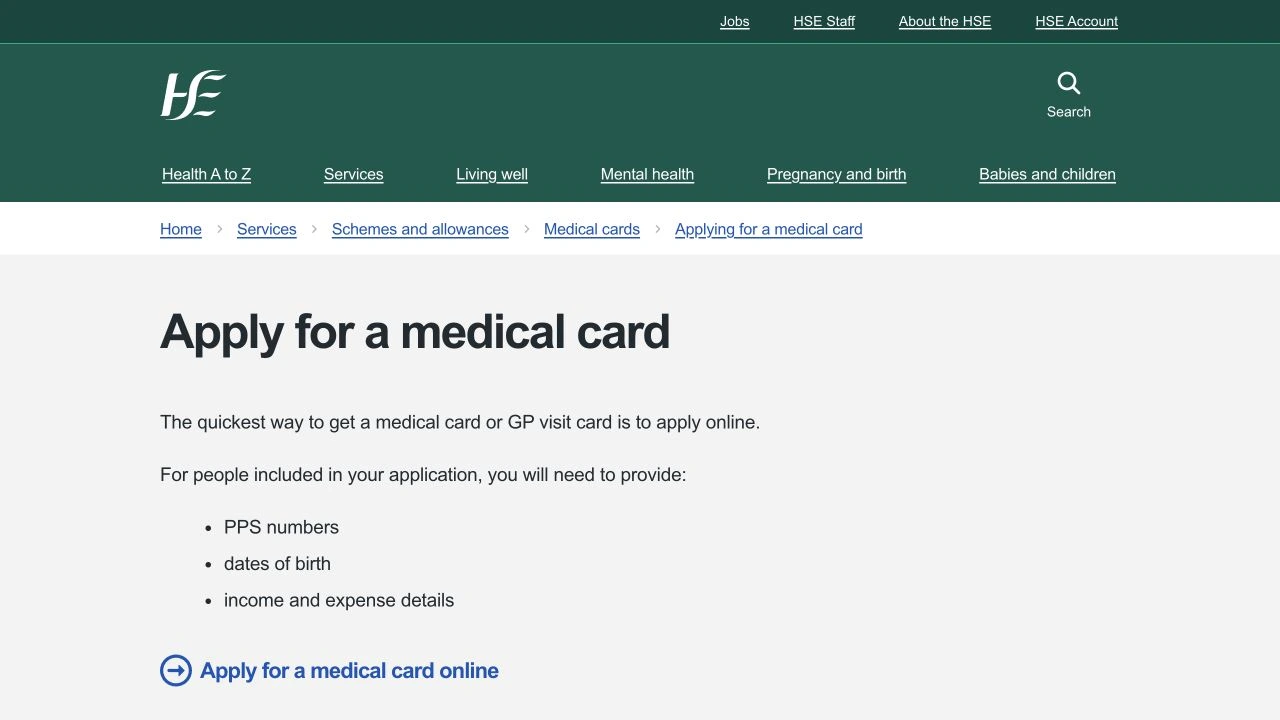
Use the HSE's official application instructions as the starting point. They link to the online application and explain the email and postal alternatives. The HSE says applying online is the quickest option.
Before beginning, gather the PPS numbers, dates of birth and income and expense information for the people included. Submit these details through the official application route. There is no reason to share them with a news website to use this guide.
For people who need a paper form or help with the process, the HSE lists 0818 22 44 78. Its application page gives a target of 15 working days to process an application and warns that missing information can make it take longer. Treat that as a processing aim, rather than a promised approval date.
Why there is no single income figure for everyone
The HSE's assessment explanation considers household circumstances, income after specified deductions and allowable expenses. These can include housing costs, childcare and travel to work. A headline salary figure alone cannot establish a household's entitlement.
Its national assessment guidelines effective from 1 April 2026 are administrative guidance, not clinical advice. This guide does not calculate eligibility or recommend a treatment.
Prepare evidence that matches the checklist
Read the HSE supporting-document checklist before uploading a bundle. Different types of income need different evidence: an employed applicant's payslip and a self-employed applicant's tax documents are not interchangeable. Date requirements also vary by document type.
A practical way to prepare is to match each declared income or expense with its requested evidence, then check that names, dates and amounts are readable. Keep a copy of the submission and respond to requests for missing information. This helps distinguish an incomplete application from a decision about entitlement.
Existing cardholders can use the HSE's card-management guidance for renewals, changed details or a lost card. A new application, a renewal and a replacement card each have their own instructions; choosing the correct route avoids starting the wrong process.

Join the conversation
Keep it kind, relevant and constructive. Comments are reviewed before they appear.
Be the first to share a thought.