

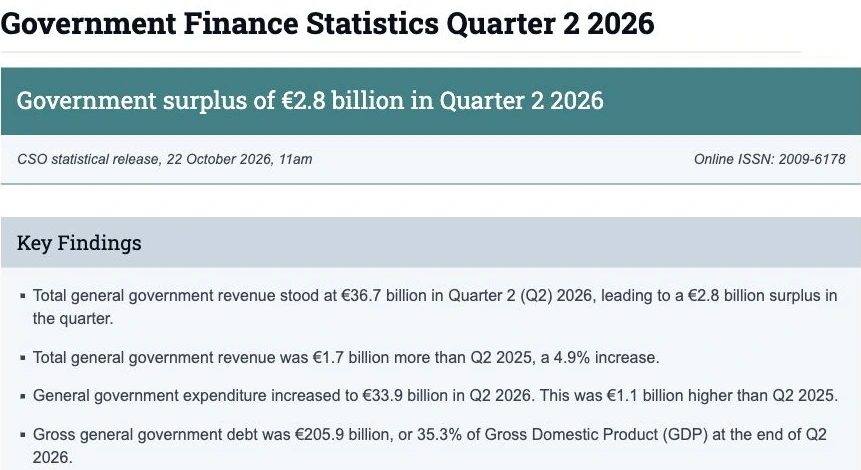
Ireland recorded a €2.8 billion general-government surplus in April–June 2026, according to figures published by the Central Statistics Office at 11am on Thursday, 22 October. Revenue rose faster than spending compared with the same quarter last year.
The new CSO quarterly release puts revenue at €36.7 billion and expenditure at €33.9 billion. Its detailed figures show a surplus of €2.794 billion, compared with €2.146 billion in the second quarter of 2025 — an increase of €648 million, calculated from the published table.
The figures describe the spring quarter. They are a statistical account of revenue and spending already recorded, rather than an announcement of additional funding today.
What changed in revenue and spending
Government revenue increased by 4.9% year on year, while spending rose by 3.3%. The CSO’s revenue and expenditure breakdown identifies higher income tax, corporation tax and VAT receipts, alongside increased social contributions.
Spending growth included approximately €700 million more in social benefits and €500 million more in pay. Those increases were partly offset elsewhere: capital transfers fell by about €300 million and spending on goods and services also declined.
The balance was €3.0 billion after seasonal adjustment, compared with €3.1 billion in the first quarter. That measure accounts for recurring differences between quarters and gives a different comparison from simply placing the unadjusted €2.8 billion beside the first-quarter figure.
Gross debt and net debt tell different parts of the story
Gross general-government debt fell by €9.6 billion during the quarter to €205.9 billion. But net debt fell by only €0.9 billion, to €139.3 billion, because relevant government financial assets also decreased.
The financial-accounts chapter records an €8.7 billion reduction in those debt-instrument assets. Reading the asset and liability movements together explains why the headline fall in gross debt was much larger than the improvement in net debt.
The CSO’s definitions and revision notes also matter when comparing these numbers with other public-finance reports. General government covers central and local government and social-security funds under a common European accounting framework; the release includes revisions to earlier quarters.
For comparisons over time, the latest tables therefore provide the consistent series to use. The quarterly surplus, the seasonally adjusted balance and the debt stock each answer a separate question about the public finances.

Join the conversation
Keep it kind, relevant and constructive. Comments are reviewed before they appear.
Be the first to share a thought.