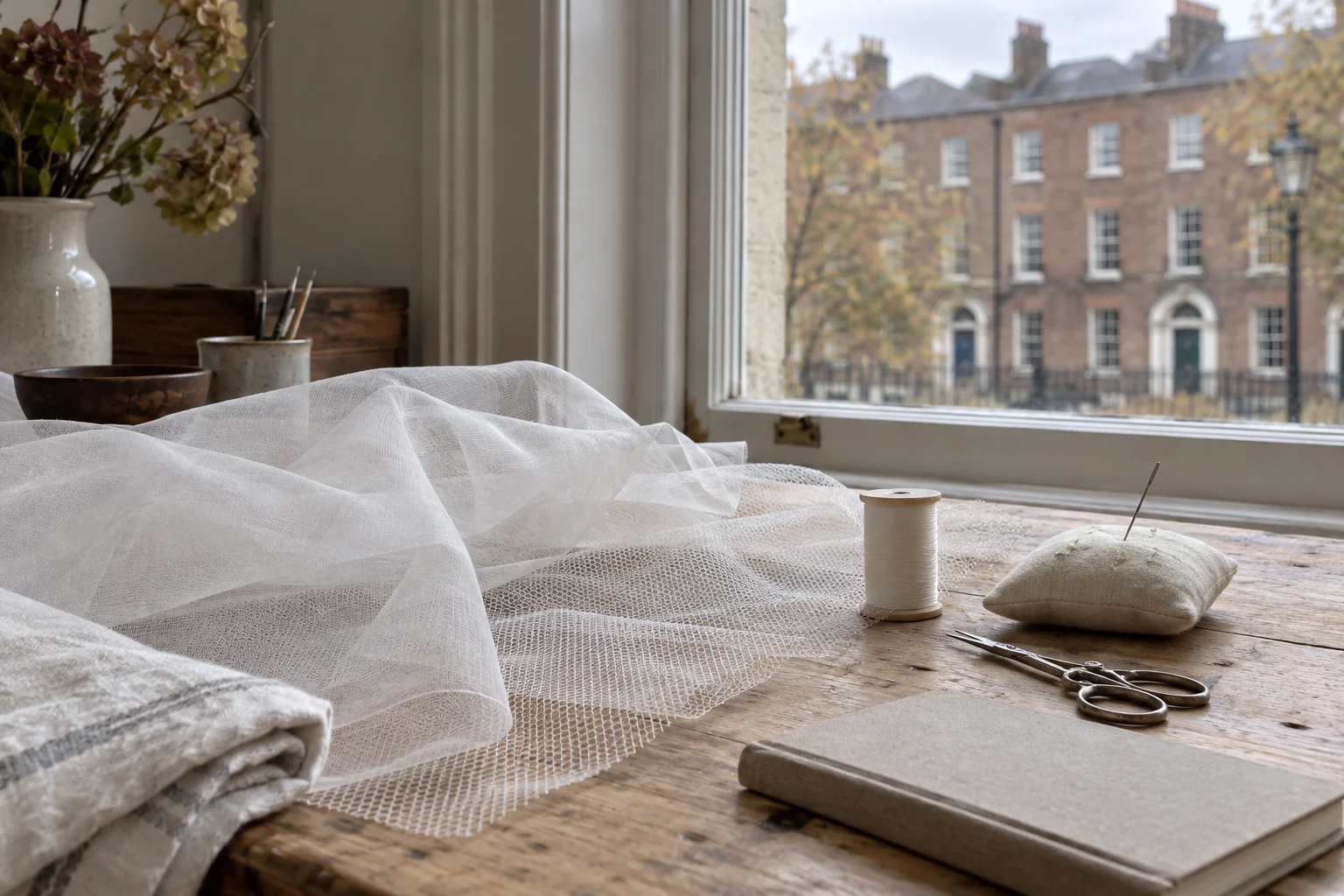
A close look at a lace edge can raise a question that a photograph of an outfit rarely answers: how was it made? An upcoming Dublin workshop offers a practical introduction to Carrickmacross lace, with Theresa Kelly teaching participants to work a butterfly design over two Saturdays in November. [2]
The class is listed in the Irish Design Week programme. For someone interested in clothing, textiles or traditional making, it offers a way to look beyond a finished surface and begin understanding the work behind it.
A technique built from layers and careful cutting
The Carrickmacross Lace Co-operative traces the craft’s local tradition to the early 1820s. Its history explains the appliqué method: fine organdie is applied to net, with excess fabric cut away to reveal the design. Decorative stitches and openwork can add further detail. [3]
That description is a useful starting point for looking at handmade lace. Notice where the fabric is retained, where an open area begins and how the edge is finished. A close view of these decisions tells you something different from the overall silhouette of a dress or accessory.
The co-operative also describes a tradition that continues to adapt to contemporary tastes. [3] Learning a historic technique does not mean every new piece must repeat an old design; the relationship between inherited skill and a maker’s choices is part of its continuing interest.
The booking covers two separate days
The organiser’s ticket page specifies Saturday 14 and Saturday 21 November, from 10am to 4pm on both days, at the United Arts Club in Dublin. It describes a two-day class, with materials provided and a limit of 10 participants. [2]
DCCI’s listing gives the venue as 3 Fitzwilliam Street Upper, D02 RR50, and displays a ticket price of €100. [1] Check the live booking page for remaining places, the final payable amount and cancellation conditions before arranging travel.
The second Saturday matters. Irish Design Week’s main advertised dates are 7–14 November, while this individual workshop continues on 21 November. [4][2] Keep both dates in the diary rather than assuming that the festival’s closing day is the end of the class.
Check suitability and access directly
DCCI marks the workshop as suitable for adults aged 18 and over. [1] Both the DCCI and organiser listings state that the venue is not wheelchair accessible. [1][2] Contact the organiser before paying if that affects your ability to attend or if you need another access arrangement clarified.
The event description says teaching starts with preparing the design and introduces working the lace, loops and finishing details. [2] If you are unsure whether your sewing experience is enough, ask what a first-time participant should be comfortable doing and what can be practised between the two dates.
Bring useful questions rather than a shopping list
Because materials are listed as included, check before buying a separate kit. Ask what participants should bring, whether any work is expected between sessions and how the taught techniques can be practised afterwards.
A realistic aim for a first class is to understand the sequence, see how a tutor handles the materials and leave knowing what needs more practice. The value lies in learning how to look and make more carefully, rather than treating attendance as proof of mastery or a guarantee of a particular finished result.
Sources were checked on 14 October 2026.
Join the conversation
Keep it kind, relevant and constructive. Comments are reviewed before they appear.
Be the first to share a thought.